Cloud vs. On-Premise: Making the Right Infrastructure Choice

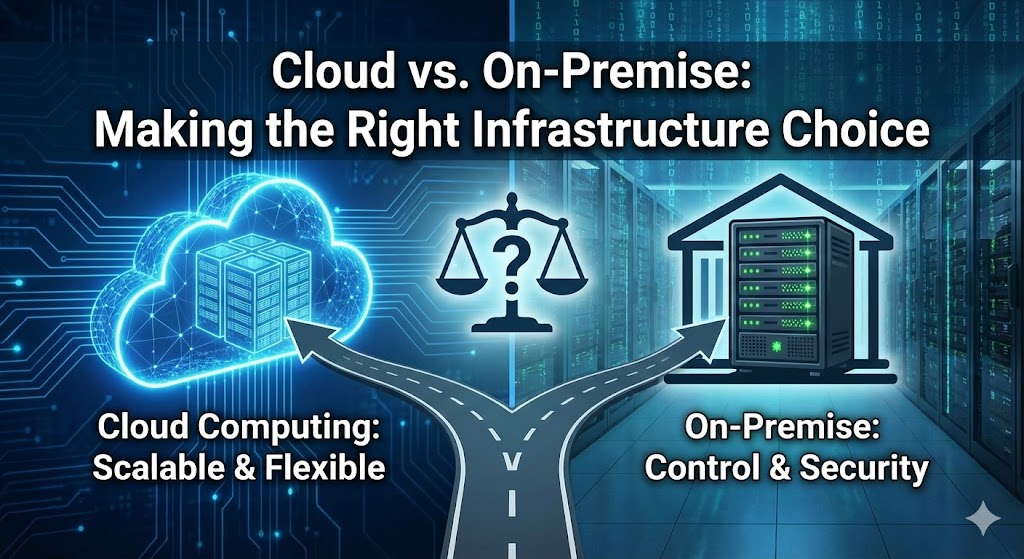
Choosing the right infrastructure is one of the most critical decisions for modern organizations.
But the big question remains:
Cloud or On-Premise?
Each has strong advantages depending on your:
- Budget
- Compliance & security needs
- Performance & scaling requirements
- Growth strategy
Let’s break it down with a DevOps & business point of view.
What is Cloud Infrastructure?
Cloud infrastructure is hosted and managed by a third-party provider such as:
- AWS (Amazon Web Services)
- Microsoft Azure
- Google Cloud Platform (GCP)
You rent compute, storage, and services — paying only for what you use.
💡 Ideal for: Startups to Enterprises focusing on agility and scalability
What is On-Premise Infrastructure?
On-Prem infrastructure is hosted within your organization — you own:
- Hardware
- Servers
- Network architecture
- Security & maintenance
You have full control, but also full responsibility.
💡 Ideal for: Industries requiring strict data control (Banking, Defense, Healthcare)
Cloud vs On-Prem — Quick Comparison
| Feature | Cloud | On-Premise |
|---|---|---|
| Upfront Cost | Low | High |
| Scalability | Highly scalable | Limited by hardware |
| Security Control | Shared responsibility | Full control |
| Maintenance | Managed by vendor | In-house required |
| Deployment Speed | Fast | Slower |
| Compliance | Can be complex | Easier local compliance |
| Performance | Depends on network | Low-latency local access |
Cost Considerations
Cloud Advantages
- No CapEx (hardware purchase)
- Pay-as-you-go model
- Lower operational staffing
On-Prem Advantages
- Better long-term value if usage is stable
- No ongoing vendor costs
Cloud wins for unpredictable workloads
On-prem wins for predictable workloads
Security & Compliance
| Cloud | On-Prem |
|---|---|
| Vendor provides strong security | You define and enforce security |
| Data stored off-site | Data stored at your location |
| Shared responsibility | Total responsibility |
If regulated by strict laws like:
- HIPAA
- RBI cybersecurity framework
- GDPR
- Defense compliance
On-Premise may be required.
Scalability & Performance
Cloud allows auto-scaling, global distribution, and load balancing with a click.
On-Prem needs:
- Hardware procurement
- Rack installation
- Manual scaling
Cloud is superior for rapid growth
On-prem may perform better for local apps with low latency needs
Hybrid & Multi-Cloud — Best of Both Worlds
Many companies today combine both approaches:
| Model | Use Case |
|---|---|
| Hybrid Cloud | Sensitive data on-prem + apps & scale in cloud |
| Multi-Cloud | Avoid vendor lock-in, distribute risk & cost |
Example:
- Database + compliance — On-Prem
- API + microservices — Cloud
Decision Checklist
Before choosing, ask:
- How critical is data security?
- Do we expect fast growth?
- CapEx budget available?
- Expertise in managing infra?
- Any regulatory restrictions?
Final Recommendation
There is no universal winner — the decision depends on your needs:
| Business Type | Recommended |
|---|---|
| Startups | Cloud |
| Fast-growing SaaS | Cloud |
| Banking/Defense | On-Prem or Hybrid |
| Enterprises with legacy systems | Hybrid |
| Cost-focused stable workloads | On-Prem |
If your business must innovate faster → Choose Cloud
If your business must control everything → Choose On-Prem